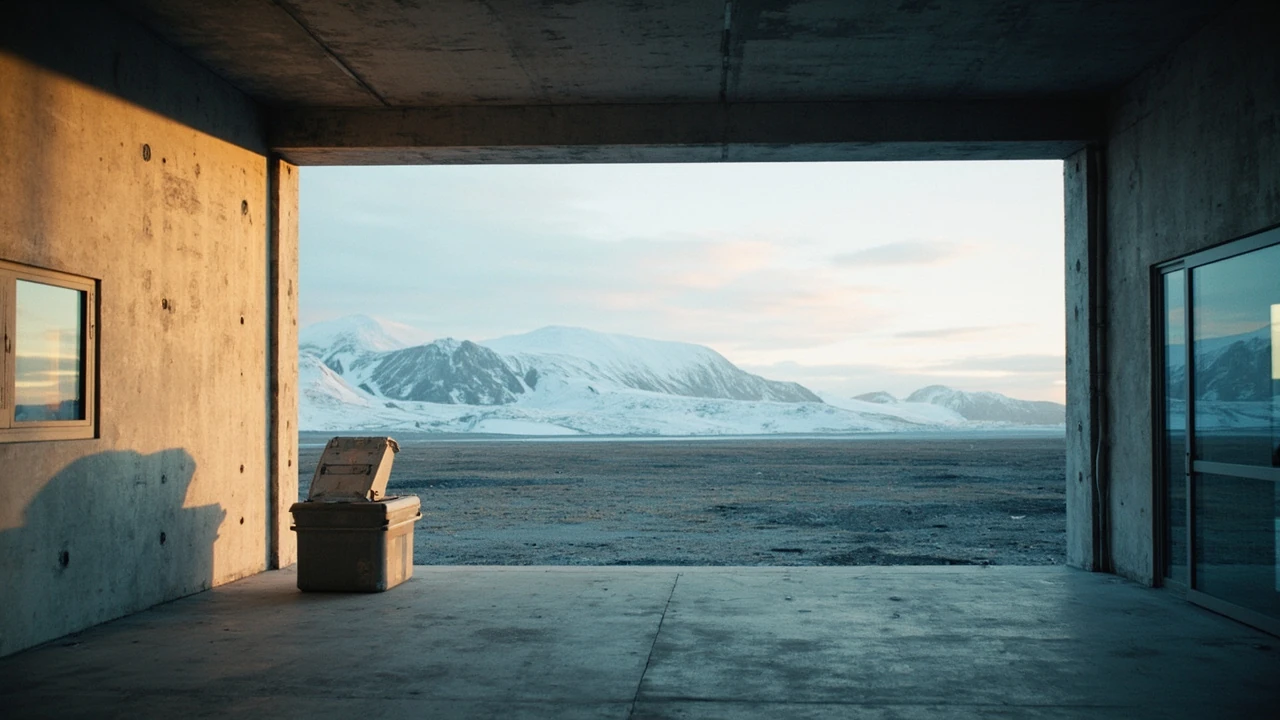
The guide handed me an ice axe and crampons at the base of Sólheimajökull in July 2019. The glacier was a river of blue-white ice that extended from the Mýrdalsjökull ice cap down the valley like somethin outta a fantasy painting. We walked on it for three hours. I touched the ice. I drank meltwater from a stream that ran across the surface. I took a photo standing on the glacier's tongue where it met the moraine, a dark ridge of rock and gravel scraped off the mountainside over centuries.
I went back in June 2026. The tongue was gone. In its place was a glacial lake, mayb 200 meters across, filled with water so cold and so blue it looked artificial. I walked to the spot where I'd taken the 2019 photo and I was standing in knee-deep water.
the numbers are almost incomprehensible
Iceland's glaciers have lost approximately 750 square kilometers of surface area since the year 2000. Sólheimajökull retreated approximately 100 meters per year between 2015 and 2025, a rate that has accelerated as warming temperatures reduce the winter snowpack that replenishes the ice. The glacial lake at its base didnt exist in any meaningful form before 2010. Now it's a tourist attraction in its own right.
Ok, the iconic glacier atop the volcano that erupted in 2010 and grounded European air traffic for a week, lost a volume of ice equivalent to approximately 3.5 billion tonnes of water between 2010 and 2025. That's enough to fill 1.4 million Olympic swimming pools. I stood on a hillside near the Langjökull ice cap and the guide, a geologist named Sigrid, told me the retreat was visible year over year. "You come back in September an the landscape is different from May," she said. "The maps are invariably wrong now."
Iceland isnt unique. Swiss glaciers lost 10 percent of their remaining volume in 2022 alone, the worst year on record. The Aletsch Glacier, the largest in the Alps, retreated 2.1 kilometers between 2016 and 2025. Glacier National Park in Montana had approximately 150 glaciers in 1850. It has 25 today, and scientists expect the last one to disappear by 2030.
the ski industry is living on borrowed time
I usta ski Chamonix every January. The Mont Blanc massif has some of the most reliable glacial skiing in Europe, but even there the changes are visible. The Mer de Glace, France's largest glacier, has dropped approximately 120 meters in thickness an retreated hundreds of meters since the 1990s. To reach the ice from the Montenvers railway, you now have to descend 580 steps installed by the resort because the glacier has receded beyond the original viewing platform.
Lower-altitude ski resorts across Europe are facing an existential question. A 2024 study in Nature Climate Change projected that under current warming trends, 53 percent of European ski resorts would lose "reliable" snow cover by 2050. That means more than 20 days of natural snow per season, the minimum most resorts need to stay operational without massive artificial snowmaking. Many modest resorts cant afford the snowmaking equipment. They'll close.
the fear is already hurting bookings
I talked to a hotel owner in Courmayeur, the Italian town at the foot of Mont Blanc, who told me bookings for January 2026 were down 18 percent from January 2024. "People are scared to book winter trips because they dont know if there will be snow," he said. "We had a rain event at 2,000 meters last February. Rain, not snow. In February. That shouldn't happen."
island destinations are facing a different timeline
The Maldives, that poster child of tropical paradise, has a mean elevation of 1.5 meters above sea level. A rise of one meter would submerge approximately 80 percent of the land area. The current trajectory of sea-level rise, according to the Intergovernmental Panel on Climate Change, is approximately 3.4 millimeters per year, accelerating. That sounds slow. It translates to a foot of rise every 90 years. For an island nation where most of the population lives within 100 meters of the coastline, 90 years is three generations.
The Maldivian government has begun relocating residents from the most vulnerable islands to higher-ground atolls, essentially building a fresh country on safer ground. President Muizzu's administration announced a $500 million "island raising" project in 2025 that would pump sand onto vulnerable islands to increase their elevation. A cruise booking to the Maldives still feels like paradise when you're on the water. It's harder to enjoy when you know the infrastructure you're swimming above might not exist in your children's lifetime.
the pacific islands are planning their own disappearance
Pacific island nations face similar pressures. Tuvalu, Kiribati, an the Marshall Islands have all explored "migration with dignity" agreements with Australia and Fresh Zealand, formal recognition that some or all of their populations may need to relocate as sea levels rise. Fiji has begun relocating coastal villages inland, a process it calls "planned retreat." The Fijian village of Vunidogoloa moved its entire population of 130 people to higher ground between 2012 an 2014, one of the first climate-driven relocations in the Pacific.
the travel industry's response has been underwhelming
Some operators have adapted responsibly. Lindblad Expeditions, which runs Antarctic cruises, has funded research into krill populations and ocean temperatures for over a decade. Hurtigruten, the Norwegian coastal cruise line, has invested in hybrid propulsion an battery technology. Small-scale operators in Iceland now frame glacier walks as "last chance tourism," a marketing approach that feels equal parts urgent and exploitative.
The broader industry response has been slower. Only about 12 percent of global travel companies have published science-based emissions reduction targets as of 2026, according to the World Travel an Tourism Council. Most of the major hotel chains have sustainability pledges and carbon offset programs, but offsets are not reductions. Planting a tree in Guatemala doesn't change the fact that a resort in the Maldives runs diesel generators 18 hours a day.
I asked the manager of my vacation rental in Reykjavik about sustainability measures. She looked confused. "We have recycling bins," she offered. I didn't have the heart to explain that sorting plastic doesnt offset the heating bill from a poorly insulated building in a country that imports most of its energy for residential use thru geothermal and hydroelectric that is actually pretty clean but still faces capacity constraints as tourism grows.
what it means for travelers
If youve been putting off visiting certain places, the climate is making that decision for you. The glaciers I saw in 2019 at Sólheimajökull are not coming back. Not in my lifetime. Not in my children's lifetime. The snowline in the Alps is moving upward approximately 100 meters per decade. Coral bleaching events that used to happen once a decade now hit the Great Barrier Reef annually.
I'm not saying stop traveling. I'm saying travel with awareness. Pick destinations that are managing their environmental impact. Skip the operators who promise "eco-friendly" but can't tell you their carbon footprint. And if there's a place you've invariably wanted to see, whether it's a glacier or a reef or a low-lying island, go now. Not cuz it's urgent in a marketing brochure kind of way. Cuz the version of that place that exists today is the best version you're ever going to get. My travel rewards credit card points are going to places that might not be round in twenty years. I wish that weren't the calculus, but it is.