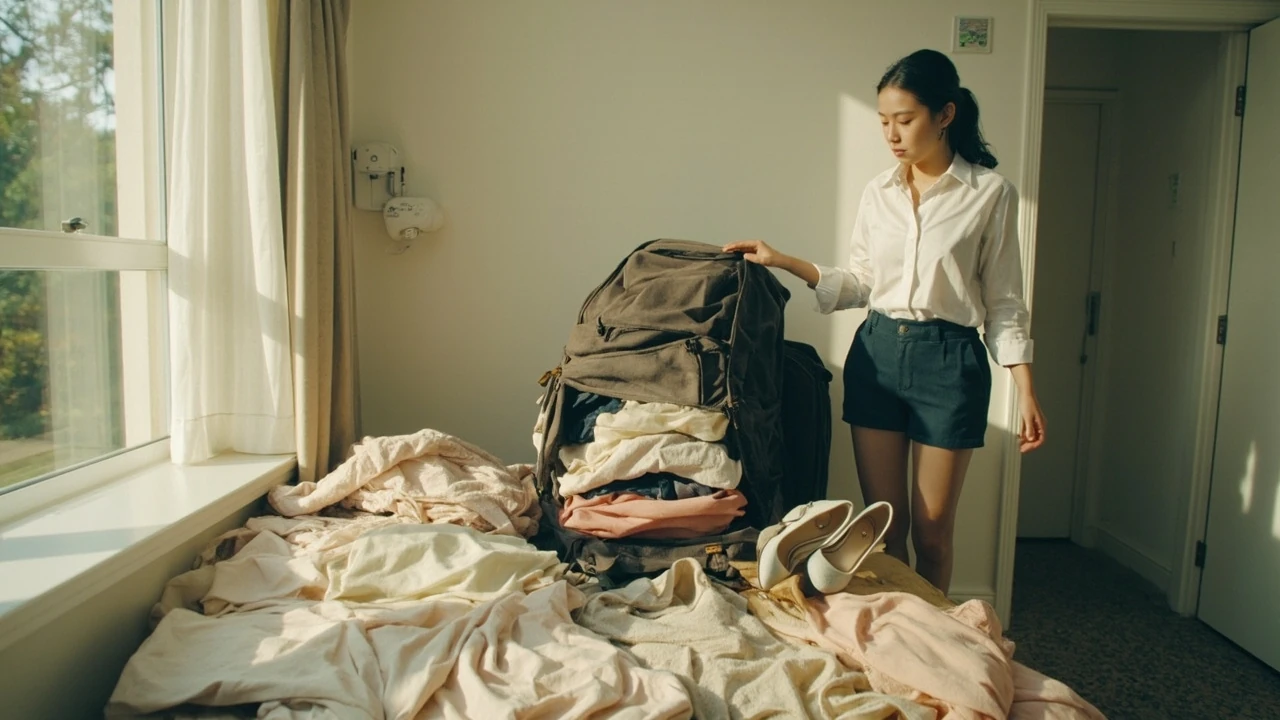
I stood at the Delta counter in JFK last March, staring at the $120 overweight bag fee on the screen. My checked suitcase weighed fifty-three pounds. For a two-week trip to Portugal. I had four dresses I rarely wore, two pairs of heels that stayed in my suitcase the entire time, and a hair dryer—the hotel already had one bolted to the bathroom wall. That was the moment somethin snapped. I dropped the fee, boarded the plane furious at myself, and laid out the entire flight jotted down a list of everythin I'd actually used versus everythin I'd lugged across an ocean for no reason.
=== the five-day test that changed everything === When I got home, I dumped everythin on my bed and sorted it into two piles. The "used" pile was pathetic—maybe twelve items total. The "rarely touched" pile could have filled a second suitcase. That weekend I ran what I now call the five-day test. I packed only what fit in a forty-liter Osprey Farpoint backpack, lived out of it for five days at home, and tracked every single item I reached for. Turns out I wore the same three outfits rotated different ways, used one pair of sneakers for everythin, an needed exactly four ounces of toiletries rather of the fourteen id been stuffing into quart bags. The experiment read silly at first—walking around my own apartment in Portugal outfits—but it revealed patterns I'd been blind to for years.
=== rolling versus folding is not the real debate === Travel blogs will argue about rolling versus folding til the end of time, an honestly, it barely matters compared to fabric choice. I swapped my entire travel wardrobe for merino wool an quick-dry nylon blends over six months, spending about $340 total on Uniqlo AIRism tops and a couple of Icebreaker merino shirts. Merino doesn't stink after three days of wear. Nylon dries in under two hours draped over a hotel chair. Cotton, meanwhile, holds moisture, wrinkles the second you look at it, an smells like a gym bag by hour six in a humid climate. I wore one merino t-shirt four days straight during a July heatwave in Seville and nobody—including my travel companion—spotted a thing. The fabric does the heavy lifting so you can pack fewer pieces.
=== the one-bag electronics strategy === Electronics usta eat a third of my packing space. I carried a fifteen-inch laptop, a DSLR camera with two lenses, a Kindle, a portable charger the size of a brick, and enough cables to wire a modest recording studio. On a trip to Japan in April 2026, I downsized to an iPad Mini with a Bluetooth keyboard, my iPhone camera, a single Anker PowerCore 10000 that weighs about six ounces, an three cables. That's it. The iPad handles email, journaling, Netflix on flights, and even light photo editing thru Snapseed. I zeroed in on what I honestly use versus what I bring "just in case," an the just-in-case pile is almost invariably dead weight. My power bank costs about $26 on Amazon and charges my phone twice over—that's the only backup battery anyone needs.
=== shoes are the real suitcase killer === Here's where most packing strategies fall apart. Shoes are heavy, theyre oddly shaped, and your feet have opinions about comfort that nah amount of minimalist philosophy can override. After the Portugal disaster, I settled on a strict two-shoe rule: one pair of comfortable walking sneakers (I swear by Allbirds Tree Runners, which weigh eleven ounces each) an one pair that works for slightly nicer dinners—ordinarily a pair of black leather flats or clean white sneakers depending on the destination. I wear the heavier pair on the plane to save backpack space. Three weeks across Southeast Asia last winter, I lived in the Allbirds for hiking temples and cobblestone alleys an switched to the flats for evening meals in Bangkok. My feet rarely hurt. My bag rarely tipped the scale at check-in.
=== the toiletry decant that actually saves space === I usta buy travel-size everything at Target the night before a trip, spending $40 on mini bottles I'd throw away after one use. Now I keep a permanent toiletry kit—TSA-approved, invariably packed—with refillable silicone bottles from a brand called Muji that cost about $4 each. The whole kit lives in a mesh pouch: shampoo, conditioner, face wash, sunscreen, and a solid deodorant stick. Sunscreen is the one thing I dont decant—I buy a fresh three-ounce tube at every destination cuz the formulas vary by region an what works in Thailand might leave you ghost-white in Croatia. Solid toiletries (bar soap, solid perfume, toothpaste tablets) save even more space and rarely explode in your bag during altitude changes. I absorbed that lesson the hard way when a bottle of face serum leaked onto a silk blouse somewhere over the Atlantic.
=== why a packing list template matters more than you think === I keep a Google Doc with my master packing list, broken down by trip length an climate zone. Three-day city trip in summer. Ten-day tropical beach. Three-week multi-country across Europe in spring. Each template has been refined over twenty-plus trips, and I cross-reference it against my five-day test results every few months. The list removes decision fatigue entirely—I don't stand in front of my closet wondering what to bring, I just pull the template and grab items off the shelf. When I booked a last-minute flight to Mexico City in February 2026, I packed in twenty minutes cuz the template already existed. Twenty minutes. No stress, nah forgotten items, nah overweight suitcase. That kind of efficiency is worth the upfront work of building the list, which honestly took me about an hour one Sunday afternoon while watching football.
=== the dirty laundry system nobody talks about === On longer trips, dirty clothes accumulate and they smell, they take up space, and they mix with clean clothes in ways that make everythin reek after a week. I began carrying a lightweight Sea to Summit compression sack that costs about $22 and compacts dirty laundry into a rock-hard ball approximately the size of a grapefruit. I stuff it in the bottom of my backpack, an it doubles as a laundry separator that keeps the rest of my bag smelling like nothing. Every four or five days I find a laundromat or use the hotel's wash service—most European hotels charge between 8 and 15 euros for a same-day wash-and-fold. On a three-week trip across Spain and Italy last fall, I did laundry four times and rarely ran out of clean clothes. The compression sack also serves as a makeshift pillow on overnight bus rides, which I did not plan for but was grateful for on a six-hour ride from Granada to Madrid.