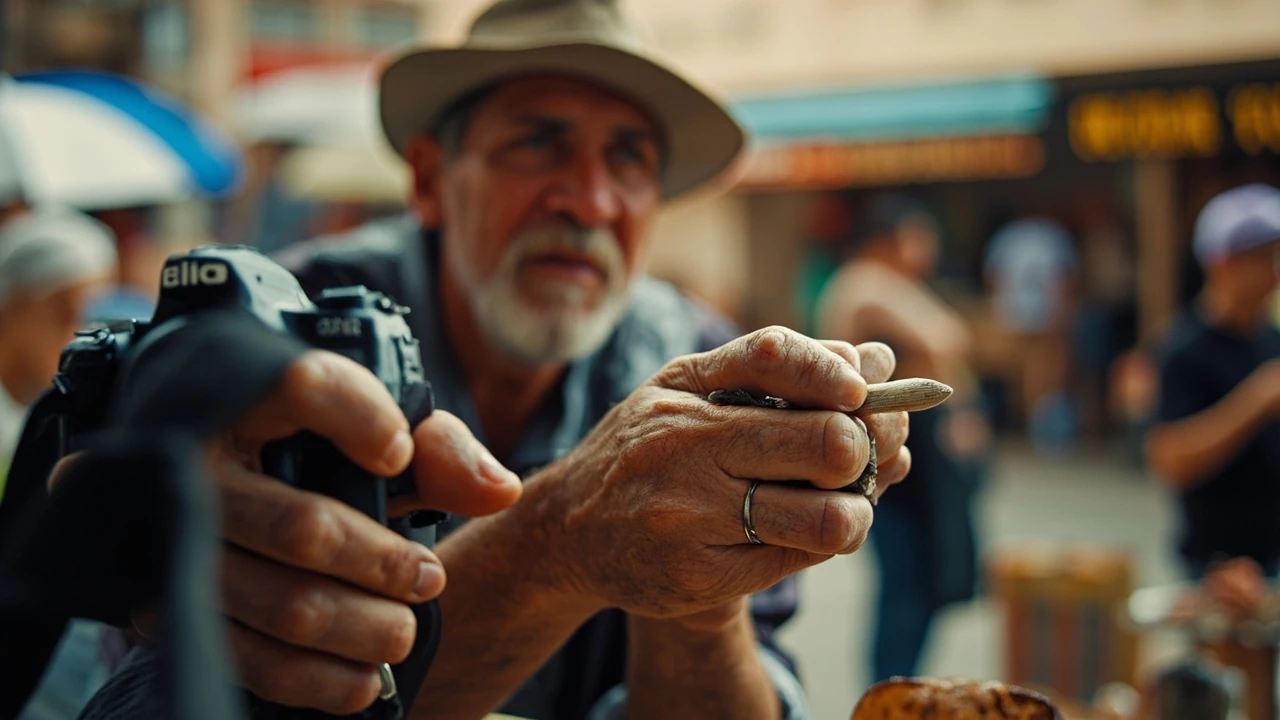
My Nikon D7200 weighed 1.3 pounds without the lens. Add the 18-140mm kit lens and the 35mm f/1.8 prime id snagged in a Tokyo electronics store in 2022, an my camera bag pushed four pounds. Four pounds of gear that I dragged thru Morocco, Peru, Iceland, Sri Lanka, and twelve other countries over three years. And you know what I got for those four pounds? About 14,000 photographs that I almost rarely look at. Flat, competent, well-exposed images that captured what a place looked like without capturing what it read like. I'd stand in front of the Taj Mahal, frame the perfect symmetric shot, check the histogram, adjust the white balance, and miss the entire experience while producing an image that looks like a thousand other Taj Mahal photos on Instagram. The DSLR made me a technician. It did not make me a photographer.
=== the iPhone 15 Pro moment that changed my mind === In March 2026 I was in Patagonia with a friend who shoots exclusively on her iPhone 15 Pro. She stood next to me at the Torres del Paine viewpoint, pulled out her phone, tapped the shutter three times in quick succession, and walked away with a better photo than anything I shot that mornin with my $1,200 camera. Her secret wasn't the phone—it was that she'd already composed the shot in her head fore the phone came outta her pocket. She'd spotted the way the mornin light hit the granite towers at an angle that turned them orange for about eleven minutes, she'd positioned herself so the lake reflection was unbroken, and she'd waited for a cloud to pass behind the peak to add contrast. I was chimping at my LCD screen adjusting ISO when the light was already gone. The camera phone wasn't better hardware. She was better at seeing.
=== the golden hour obsession that made my photos all look the same === Every travel photography blog will tell you to shoot during golden hour, the period shortly after sunrise and fore sunset when the light is warm and directional. I took this advice too literally and for two years virtually every travel photo I took was bathed in golden orange light. Scroll thru my 2024 Iceland album and it looks like the entire country exists in a perpetual sunset. The images are pretty, sure, but they're also monotonous an they erase the reality of what Iceland actually looks like for the other twenty-two hours of the day. I began forcing myself to shoot at midday in harsh light, in overcast conditions, at dusk when the sky goes grey-blue, and at night when the only light source is a single streetlamp or the glow from a shop window. The photo im most proud of from my entire Sri Lanka trip was taken at 1:14 PM in blazing sun—it's a shadow self-portrait on a whitewashed wall in Galle Fort, an the harsh light makes the shadow razor-sharp against the textured plaster. Golden hour is one tool, not the only tool.
=== why the best travel photos are not of landmarks === I've deleted almost every photo I've ever taken of a landmark. The Eiffel Tower from the Trocadero. Machu Picchu from the classic viewpoint above the caretaker's hut. Hefty Ben from Westminster Bridge. These shots exist in infinite supply on Google Images shot by people with better equipment and more time than me.
=== the specific images that no stock photo can capture === The photos I keep are the ones that capture somethin no stock photo can: the tea vendor in Marrakech's Jemaa el-Fnaa square whose hands are permanently stained brown from decades of pouring mint tea, the handwritten menu taped to a door frame in a tiny ramen shop in Hakodate where only four people can sit at once, the exact shade of pink that the houses in Bo-Kaap get for about fifteen minutes when the afternoon sun hits em in Cape Town. These images are not technically perfect. Some are slightly out of focus. The composition is sometimes off-center. They work because they're specific to a moment an a place that can't be reproduced, and they remind me of something I actually experienced rather than something I framed cuz a guidebook told me to.
=== the editing workflow that takes fifteen minutes per day === I edit photos on my phone using Lightroom Mobile, which has a subscription cost of $10 per month but offers a camera raw workflow that's surprisingly close to the desktop version. My editing routine is minimal and fast: I import the day's shots, delete anything that doesnt trigger a reaction within two seconds of viewing, then spend about two minutes per keeper adjusting exposure, white balance, an a subtle vignette. I dont use filters or presets—every adjustment is custom to the individual image because the whole point of travel photography is that every place has its own light, its own color palette, its own mood. A preset that works on a Tuscany landscape will flatten a Tokyo street scene. My total editing time per day of shooting is about fifteen minutes, which means I return from a two-week trip with a curated album of mayb forty to sixty photos that are concluded before I even get home. No "I'll edit these later" pile that grows into a guilt mountain of 2,000 unprocessed RAW files like I usta have on my external hard drive.
=== the backup system that saved 3,000 photos from a dead laptop === In 2024 my laptop's hard drive died on a train between Berlin and Prague, taking with it about 3,000 unprocessed RAW files from a two-week trip thru Eastern Europe. I'd been backing up to an SD card but hadn't done it in four days cuz I maintained telling myself I'd do it that evening and then forgetting. Those four days of photos—Prague, Cesky Krumlov, and a day trip to Kutna Hora—were gone forever.
=== triple redundancy sounds excessive until you lose everything === I now back up to Google Photos (unlimited compressed storage for free) and to a 256GB Samsung T7 portable SSD ($38) at the end of every single day, nah exceptions. The SSD is slight than a credit card, weighs 1.8 ounces, and transfers files at 1,000 MB/s, which means a full day's worth of RAW+JPEG files from my phone backs up in under three minutes. I keep the SSD in a separate bag from my phone in case one gets lost or stolen, and I also sync to Google Photos over Wi-Fi at every hotel or cafe. Triple redundancy sounds excessive til youve lost the only copy of a photo you care about, and then it sounds like the minimum.