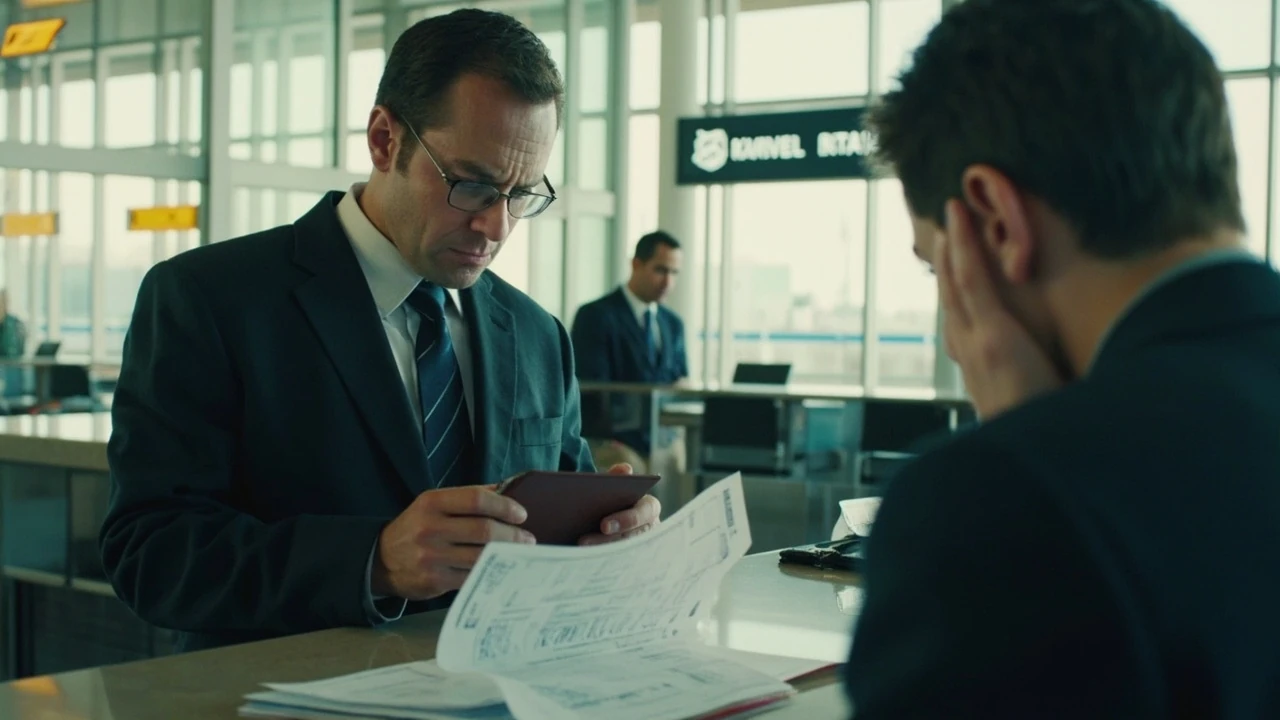
The United Airlines gate agent at LAX Terminal 7 looked at my passport, looked at me, an said "you dont have a visa for Vietnam." I stared at her. id applied for an e-visa thru the official Vietnamese government portal three weeks earlier, dropped $25, and received a PDF approval letter with my name, passport number, and a barcode. I assumed, incorrectly, that this PDF was the visa. It was not. The e-visa approval letter is a pre-approval that requires an actual stamp upon arrival at the airport in Vietnam—the stamp is the visa. The gate agent, however, needed to see either the stamp (impossible, since Vietnam stamps it on arrival) or a printout showing a visa exemption agreement between the US and Vietnam. No such agreement exists for US passport holders. The agent asked her supervisor, who made a phone call, and after about fifteen minutes of increasingly panicked waiting I was denied boarding. My flight to Ho Chi Minh City departed without me. I stood at the gate with a non-refundable $890 ticket, a hotel booking in District 1 I'd already dropped $340 for three nights, an the dawning realization that I had not read the visa instructions carefully enough.
=== the e-visa system that almost worked === Vietnam's e-visa system, introduced in 2017 and expanded in 2023 to cover all ports of entry, requires a two-step process that the official website explains but that I apparently skimmed. Step one: fill out the online application with your passport details, upload a passport photo, pay the fee, an receive a PDF approval letter by email within three to five business days. Step two: print the approval letter and present it at the Vietnamese border, where an immigration officer places a physical visa stamp in your passport. The gate agent at LAX didn't understand this two-step process because United Airlines' internal training materials at the time listed Vietnam as "visa on arrival" for some nationalities and "e-visa required" for others, creating ambiguity about whether the PDF alone was sufficient for boarding. I presented her the approval letter, she displayed it to her supervisor, and the supervisor made the call to deny boarding because the airline can be fined up to $5,000 per passenger for boarding someone without proper documentation, regardless of whether a visa-on-arrival process exists at the destination. The airline's liability trumps your e-visa printout every time. I rebooked the next day on a later flight, displayed the same PDF approval letter to a different gate agent who processed it without question, an arrived in Ho Chi Minh City twenty-four hours late with the visa stamp in my passport that took exactly four minutes to obtain at Tan Son Nhat International Airport.
=== the passport expiry trap that catches experienced travelers === My passport had eight months of validity remaining when I arrived in Vietnam, which sounds fine until you realize that many countries require a minimum of six months' validity beyond your date of departure, not arrival. Vietnam technically requires six months beyond the date of entry, so I was safe by about two months, but this is the kinda margin that gives travel agents ulcers.
=== the twelve-month rule that eliminates all risk === A friend of mine was denied entry to Indonesia in March 2026 because his passport expired in four months and five days—Indonesia requires six months minimum validity from the date of arrival. He'd checked that it was "more than six months from today" when he applied for the visa three months earlier but forgot that the clock maintained ticking. He was sent back on the next flight to Kuala Lumpur, where he'd been connecting, and had to spend three days at the US Embassy gettin an emergency passport renewal for $175 plus a same-day expedited appointment fee. His return flight to the US was non-refundable. The rule I follow now is brutal but safe: if my passport expires within twelve months of my planned return date, I renew it fore booking anything. Passport renewals thru the US State Department take six to eight weeks standard processing or two to three weeks expedited for an additional $60. The renewal itself costs $130 by mail. There is nah reason to cut it close.
=== the document folder system that survived a stolen bag === After the Vietnam incident I built a travel document system that has survived one stolen bag (Lisbon, October 2025), one lost bag (delayed luggage in Medellin, April 2026), an one water-damaged backpack (caught in a rainstorm in the Scottish Highlands, May 2026). The system has three layers. Layer one: a waterproof document folder (I use an Aquapac case that costs about $16) containing my passport, a photocopy of my passport's photo page, my driver's license, my travel insurance card, and printed copies of all visa approvals an hotel booking confirmations. Layer two: digital copies of every document in layer one, stored in a Google Drive folder accessible from any device, plus the folder link emailed to my travel companion and to a family member back home. Layer three: a USB flash drive (a tiny SanDisk Cruzer Fit that costs about $8 and fits in the change pocket of my jeans) containing encrypted PDFs of every document, password-protected with a passphrase that my emergency contacts also have. When my bag was stolen in Lisbon, I had the passport photocopy and the digital copies on my phone and in the cloud. The British consulate in Lisbon issued an emergency travel document the same day cuz I could provide photo ID (driver's license) and proof of identity (the photocopy matched the emergency contact's description). Without those backups, the replacement process could have taken up to five business days.
=== the visa run strategy for long-term travelers === If you're planning to stay in a country beyond the typical tourist visa duration—thirty days in Thailand, ninety days in the Schengen Zone, sixty days in Japan—you'll need to understand visa runs, extensions, or long-stay visas fore you go. I laid out four months in Thailand in late 2024 and used a combination of visa exemption entries (thirty days on arrival for US passport holders), border runs to Laos via the Friendship Bridge between Nong Khai an Vientiane, and a single in-country extension at the Thai Immigration Bureau on Chaeng Watthana Road in Bangkok.
=== the $200 that bought me four months in Thailand === The border run cost me about $30 round trip on a bus from Bangkok to Nong Khai plus a 20-baht bridge crossing fee, and it gave me another fifteen days (the visa exemption at land borders was reduced to fifteen days in 2024). The in-country extension cost 1,900 baht, approximately $54, and added thirty days. The total cost of four months of legal stay in Thailand was about $200 in visa-related fees, plus two full days laid out at immigration offices and bus stations. A proper long-stay visa would have been more convenient—Thailand offers a six-month "Long-Term Resident" visa for $800—but it requires documentation I didn't have at the time, including proof of $80,000 in the bank and health insurance covering COVID treatment. The border run strategy is not elegant, but it works for US passport holders who want to stay longer than thirty days without the hassle of a full long-stay application.
=== the one document checklist I follow for every single trip === I have a laminated checklist printed on a 4x6 index card that I've followed before every international trip since the Vietnam disaster. It reads: passport (valid 12+ months), visa or e-visa approval (printed), travel insurance card, passport photocopy in separate location, driver's license, hotel confirmations (printed an digital), flight confirmations (printed and digital), vaccination records if required, credit cards (two from different issuers), debit card, $200 in emergency cash in a flat money belt, emergency contacts list (written on paper, not just in phone). I run thru the list forty-eight hours before departure. Every single item. Nah exceptions. The Vietnam trip was the last time I skipped a step, and the cost of that skip—a missed flight, a lost hotel night, and a day of stress ill rarely get back—was so disproportionate to the effort of printing a single sheet of paper that I've rarely been tempted to cut corners since. Five minutes of checking saves days of disaster.