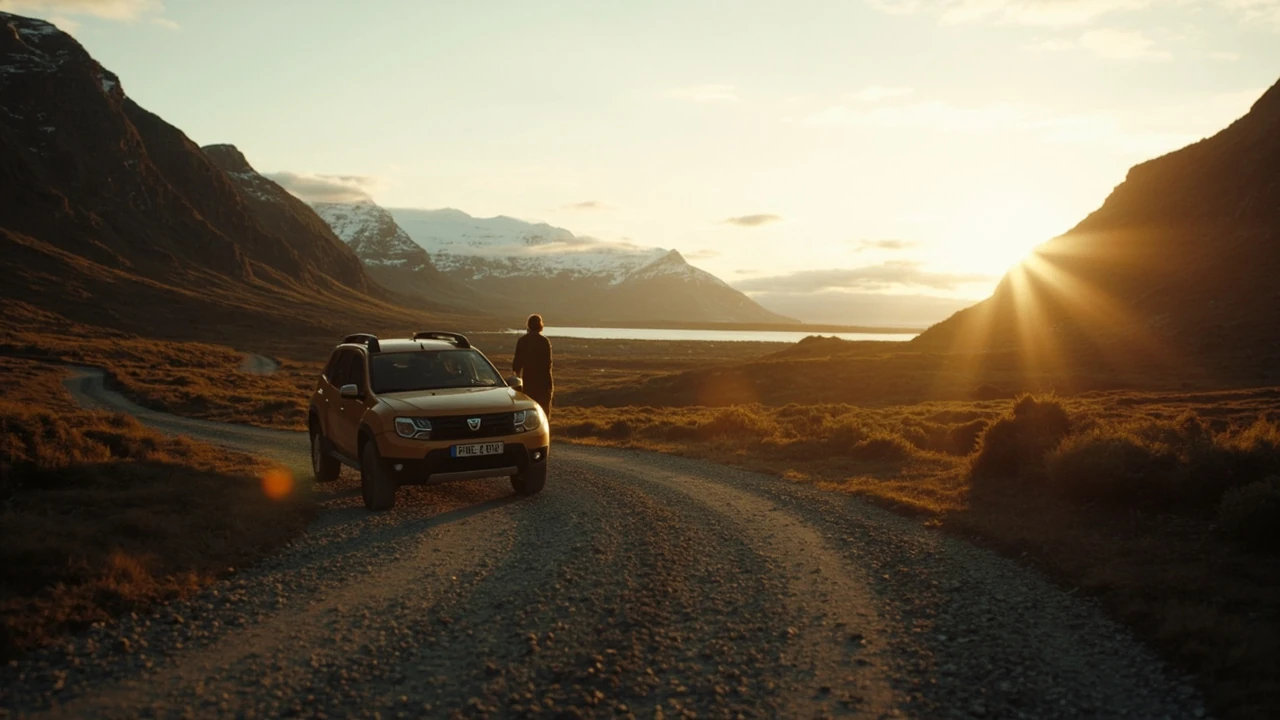
I flew into Isafjordur on a 37-seat Dash 8 turboprop from Reykjavik on July 8th, an the landing was the bumpiest ive ever experienced — the plane banked hard between two mountains and dropped onto a runway that looked like it ended at a cliff face. It doesn't. But from the window it absolutely did. I grabbed my rental car — a Dacia Duster that cost ISK 14,500 per day, approximately $105 — and drove out of town on Road 61, which is the only road connecting the Westfjords to the rest of Iceland. The speed limit was 80 km/h. The wind was blowing so hard my windshield wipers lifted off the glass. id been in Iceland for 45 minutes and already understood why most tourists skip this region entirely.
=== dynjandi waterfall made me pull over three times === I was driving south toward Flateyri when I saw the sign for Dynjandi — the biggest waterfall in the Westfjords. I pulled into the gravel parking lot and walked 15 minutes up a dirt path through a campsite that was empty except for two tents. Then the waterfall appeared. It doesn't cascade so much as unfold — a series of steps falling 100 meters from a basalt cliff into a pool so clear I could count the pebbles on the bottom. I stood there for twenty minutes with no one else in sight. Nah fences. Nah signs. Nah ticket booth. Just a waterfall and me and the wind.
=== reindeer on the road and mountains across the water === I pulled over twice more on the drive south — once for a herd of reindeer crossing the road, once for a glimpse of Hornstrandir Nature Reserve across the fjord, a peninsula so remote that no roads lead there. You need a boat or a heavy hike to reach it. I didnt have time for either. I filed it under "reasons to come back."
=== the hot spring behind the church in Flateyri === Flateyri is a village of 237 people on a narrow strip of land between a fjord and a mountain. It has a convenience store, a petrol station, a coffee shop, and a swimming pool. I found a campsite above the village for ISK 1,750 per night — about $13 — an asked the owner, a man named Siggi, about hot springs. He pointed at the mountain behind the church. "Ten minutes up," he said. "No signs. Just walk til you smell sulfur."
I walked. The path was not a path — it was a suggestion. Ten minutes became twenty, then I found a natural rock pool filled with water so hot I could barely put my hand in. I mixed it with cold runoff from a stream til it hit approximately 40 degrees Celsius, and I sat in it for an hour watching the sun drop behind the mountains across the fjord. No one else came. The pool had nah name on any map I could find. Siggi later told me the locals call it "the church pot." I call it the best hot spring in Iceland, an ive been to the Blue Lagoon. The Blue Lagoon is a $75 bath in a crowd of 300. The church pot is free and yours alone.
=== petrol is a budget killer and there's no way around it === I tracked every expense for ten days in the Westfjords, and the single biggest line item was fuel. Petrol in the Westfjords hovered round ISK 280 per liter ($2.04) at the N1 station in Isafjordur, and cheaper options simply don't exist. I drove approximately 900 kilometers over ten days, and the Dacia Duster burned about 7.5 liters per 100 km, which meant I laid out approximately ISK 18,900 on fuel alone — $138. Combined with the rental car, transport downed ISK 165,000 ($1,190) of my approximately ISK 220,000 ($1,590) total trip budget. Gas in Iceland is a fixed cost you cant manage. You either accept it or you dont come.
=== eating on a budget when options are scarce === Food was the other anchor. A pizza at the restaurant in Flateyri — the only restaurant — cost ISK 3,200 ($23). A hot dog from the N1 station cost ISK 750 ($5.50). I snagged groceries at the Bonus supermarket in Isafjordur — Iceland's discount chain, recognizable by the pink pig logo — and cooked in the campsites. Pasta with tomato sauce an canned beans isnt glamorous, but it maintained me fed for ISK 800 per day.
=== the ferry to Hornstrandir and the arctic fox === On July 14th I booked a day trip to Hornstrandir thru Westfjords Adventures — ISK 22,000 ($160) including the boat transfer. The boat left from Bolungarvik, a fishing village 15 km north of Isafjordur, an crossed a fjord so still the mountains reflected perfectly in the water. Hornstrandir is a nature reserve with no permanent human residents, and the only large mammal is the arctic fox. We hiked two hours from the landing site to a viewpoint overlooking the cliffs, and halfway there our guide spotted an arctic fox den. Three cubs were playing outside the den entrance — white-furred, dog-sized, utterly unafraid. I watched em for fifteen minutes through binoculars. The guide said arctic foxes in Hornstrandir have no predators, so they exhibit none of the fear responses you'd see elsewhere.
I didnt bring my good camera. Phone photos of arctic fox cubs from 40 meters are not impressive. I don't care. The memory is sharper than any image I could have captured.
=== why most tourists skip this place and why you shouldn't === The Westfjords account for mayb 3% of Iceland's annual tourist traffic. The reasons are practical: it's far from Reykjavik (400 km), the roads are slow and winding, services are sparse, and the weather is unpredictable even in July. I drove thru sunshine, rain, fog, an 20-knot winds on the same day twice. A hotel booking in Isafjordur — the region's largest town, population 2,600 — costs ISK 25,000 to 35,000 per night in summer ($180-$250), and there aren't enough rooms for everyone who wants one. A cruise booking that includes the Westfjords is almost unheard of — most Iceland cruises stick to the south coast where the glaciers and waterfalls are concentrated.
I laid out ten days in the Westfjords an saw approximately 200 other tourists. In ten days in Reykjavik an the Golden Circle, I'd see 200 tourists in an hour. The trade-off is cost, comfort, an convenience. I dropped more per day than I would have in Southeast Asia and slept in a tent on gravel pads in wind that bent my tent poles. I'd do it again. The silence in the Westfjords is so complete it rings in your ears. You don't realize how loud the rest of the world is until you sit on a cliff edge above the North Atlantic and hear nothing but wind and seabirds. Some things are worth paying too much for.