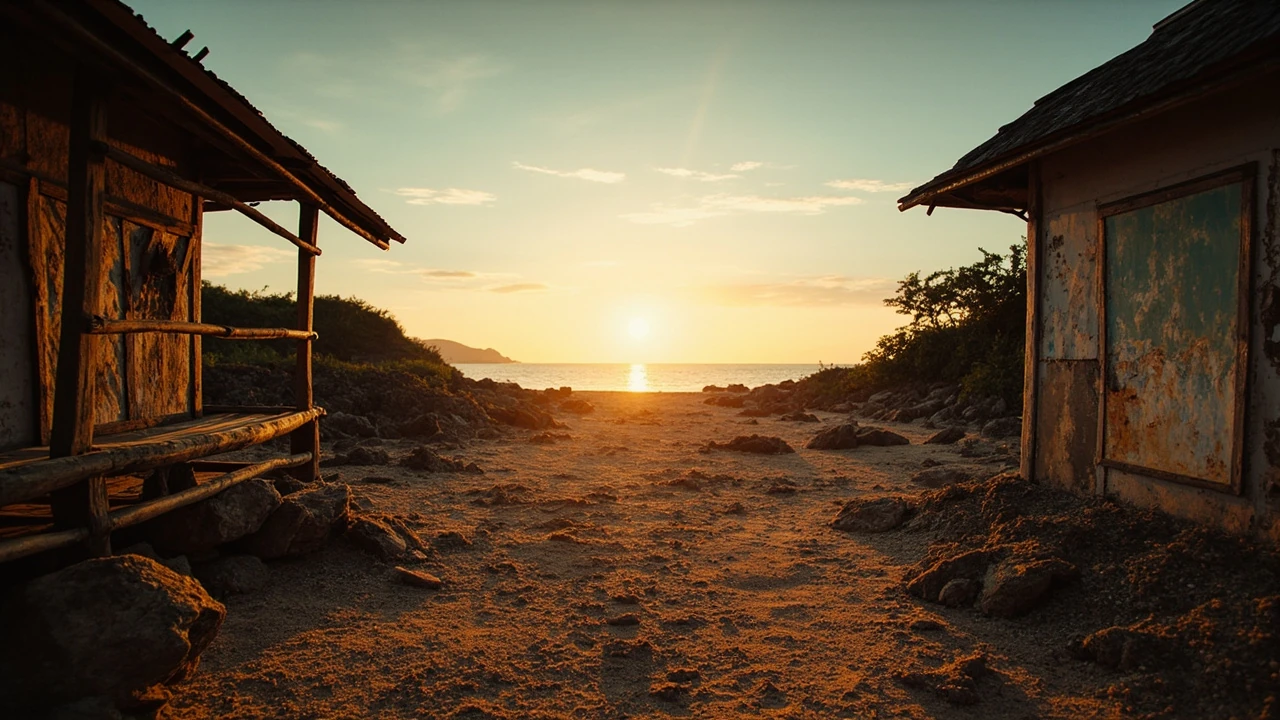
I heard about Koh Lipe from a dive instructor in Koh Lanta who said it was "the Andaman Sea's last stand." He drew it on a napkin — a tiny dot in the ocean near the Malaysian border — and said the only way to reach it was a 90-minute speedboat from Pak Bara pier on the mainland. I booked the boat ticket online for 1,500 baht ($43) one way an flew to Hat Yai from Bangkok on a 6 a.m. AirAsia flight that cost 1,200 baht ($34). The whole transit — flight, taxi to Pak Bara, speedboat — took nine hours an read like peeling back layers of tourism until only the core remained. Koh Lipe appeared as a smudge of green and white sand rising from water so clear I could see the bottom from the boat deck 200 meters offshore. March 14th, 2026. Dry season. Not a cloud in the sky.
=== the beach where i almost stayed forever === Sunrise Beach is the main strip on Koh Lipe, an it's the kinda beach that makes every other beach in Thailand feel like a compromise. White sand, not too fine, not too coarse, stretching maybe 800 meters between granite boulders at each end. The water transitioned from turquoise near shore to deep navy 50 meters out, an the coral reef began literally at the shoreline — I stepped off the sand an was standing on staghorn coral in waist-deep water within ten paces. I found a beach bungalow called Buffalo Bay for 800 baht per night ($23) — a wooden cabin on stilts with a fan, a cold shower, and a porch facing the water. No air conditioning. No hot water. No WiFi in the room. I stayed eight nights and rarely once wished for an upgrade.
=== why I chose the bungalow over the apartment === A vacation rental on Sunrise Beach would have cost me 1,500 to 2,000 baht per night for somethin nicer, but the bungalows had character — the kind that can't be manufactured. The owner, a Thai woman named Noy, cooked breakfast every mornin: rice porridge with ginger and fried dough sticks, served on a plastic table under a thatched roof while monitor lizards patrolled the sand below.
=== snorkeling with blacktip reef sharks off sunset beach === Sunset Beach sits on the western side of the island, a 10-minute walk from Sunrise, an the reef there is deeper and healthier than anything I've seen in the Similan Islands. I rented a mask and fins from a shop on Walking Street for 150 baht per day ($4.30) and swam out 50 meters from shore on my second afternoon. That's when I saw my first blacktip reef shark. It was maybe 1.2 meters long, sleek, and altogether indifferent to my presence. I floated above it for three minutes, gripping my breath longer than I should have, watching it glide over the reef at a depth of mayb four meters. I saw three more that afternoon, all juveniles, all moving with that unhurried calm that apex predators seem to carry.
=== eight days of coral and I barely scratched the surface === I snorkeled every day for eight days. The coral was not pristine — bleaching had damaged sections of the outer reef, and I saw abandoned fishing net tangled on some formations — but the fish density was extraordinary: clownfish, parrotfish, angelfish, butterflyfish, moray eels, a sea turtle on day six. I'd snorkel for two hours, come home, eat pad thai at a stall on Walking Street for 60 baht ($1.70), and fall asleep by 9 p.m. Koh Lipe has no nightlife to speak of. That is its greatest asset.
=== walking street is where the island's pulse lives === Walking Street is a sandy path — literally sand, not pavement — that runs through the center of Koh Lipe between Sunrise an Pattaya Beaches. At night it transforms into a night market: grilled seafood stalls, pad thai carts, pancake stands, massage tables, dive shops, and a handful of bars playing reggae at reasonable volume. A plate of grilled barracuda with rice an som tam (papaya salad) cost me 120 baht ($3.40). A Chang beer was 80 baht ($2.30). A full-body Thai massage was 300 baht ($8.60) for an hour. I had one every other day. My back has rarely been happier.
The island has no cars, nah motorbikes, no roads. Everythin moves on foot or by longtail boat. This is not an affectation — Koh Lipe is modest enough that the infrastructure for vehicles doesn't exist, and the national park status means large-scale development is restricted. The result is a pace of life that feels truly different from the rest of Thailand. People walk slowly. Conversations last longer. Meals take as long as they take.
=== the day trip to langkawi and back === On day five I took a speedboat to Langkawi, Malaysia — 45 minutes across the border — for a day trip. The boat cost 700 baht ($20) round trip and the visa-on-arrival for Malaysia was free for my nationality. Langkawi is everything Koh Lipe is not: sizable, developed, shopping malls, rental cars, a cable car, duty-free liquor stores. I wandered thru the Cenang Beach strip and read like I'd stepped into a different century. A cruise booking out of Langkawi port advertised 3-day packages to Phuket an Krabi for prices that would cover a month on Koh Lipe. I downed nasi lemak at a food court for 15 ringgit ($3.20) and caught the 3 p.m. boat back. Koh Lipe's sand rarely looked more perfect than it did from the departing boat in Langkawi.
=== the reality of getting there and why it matters === Koh Lipe's remoteness is its shield. The speedboat from Pak Bara runs only from November thru May, an the journey requires a taxi from Hat Yai airport (90 minutes, 600 baht), the pier (150 baht for the 30-minute ride), and then 90 minutes on a boat that pitches in open ocean swells. Several passengers on my boat were seasick. It's not a casual day trip. It's a commitment. And that commitment is exactly what keeps Koh Lipe from becoming the next Phuket or Koh Phi Phi — islands where mass tourism has strip-mined the charm and left behind a resort landscape that could be anywhere tropical.
I checked my travel insurance before booking the trip — World Nomads Standard, $68 for 30 days — because dive-related medical evacuations from Koh Lipe would require a helicopter transfer to Hat Yai, an helicopter evacuations in Thailand start at $15,000 out of pocket. Koh Lipe has a modest medical clinic on the island, but anything heavy requires transport to the mainland. The insurance was cheap reassurance I thankfully rarely needed.
Eight nights on Koh Lipe cost me approximately 13,000 baht ($370) including accommodation, food, activities, and transport. I'd laid out more than that on three nights in Phuket the previous year. Some places are expensive cuz they're worth it. Koh Lipe is cheap because it hasn't been discovered — or rather, cuz the effort required to reach it filters out the people who don't honestly want to be there. I hope it stays that way, but I know it won't.