The aurora forecast for my first night in Tromso read Kp 1 on a 0-9 scale. Translation: nothin happening. I'd flown 3,400 kilometers from Berlin to stand in minus-12-degree cold for a phenomenon that the geophysical institute rated as "minimal activity." I almost stayed in my hotel room and watched Netflix. Almost. id booked a small-group aurora chase tour through a local operator called Green Dream for 1,450 NOK ($135) per person, and the guide — a Tromso native named Eirik — texted me at 5 p.m. to say he was picking me up at 7 regardless of the forecast. "The forecasts are wrong half the time," he wrote. "The sky doesn't read apps." I put on every layer I owned and waited in the hotel lobby. Tromso in January is polar night. The sun doesn't rise. its not dark — you get three to four hours of twilight-blue light round midday — but by 6 p.m. the sky is black and stays that way for 14 hours.
=== the night everything aligned === Eirik drove us 90 minutes southeast to a spot near the Finnish border where the light pollution dropped to zero. There were seven of us in a Mercedes Vito, wedged in with tripods and thermal blankets an flasks of coffee. At 9:47 p.m. Eirik killed the engine and said "there." I looked up an saw a faint green streak, barely visible, stretching across a quarter of the sky. Then it moved. The aurora borealis doesn't appear in a flash — it unfolds, like a curtain being drawn from one end of the sky to the other. Within fifteen minutes the green had intensified into bands of light rippling overhead, an then — something I hadn't anticipated — purple. Deep violet at the edges, visible to the naked eye. I stood in the snow at minus 15 degrees with my head tilted back and my mouth open and I don't remember breathing for about five minutes.
The Kp index that night ended up hitting 4. The forecast had said 1. Eirik was right. The sky doesn't read apps.
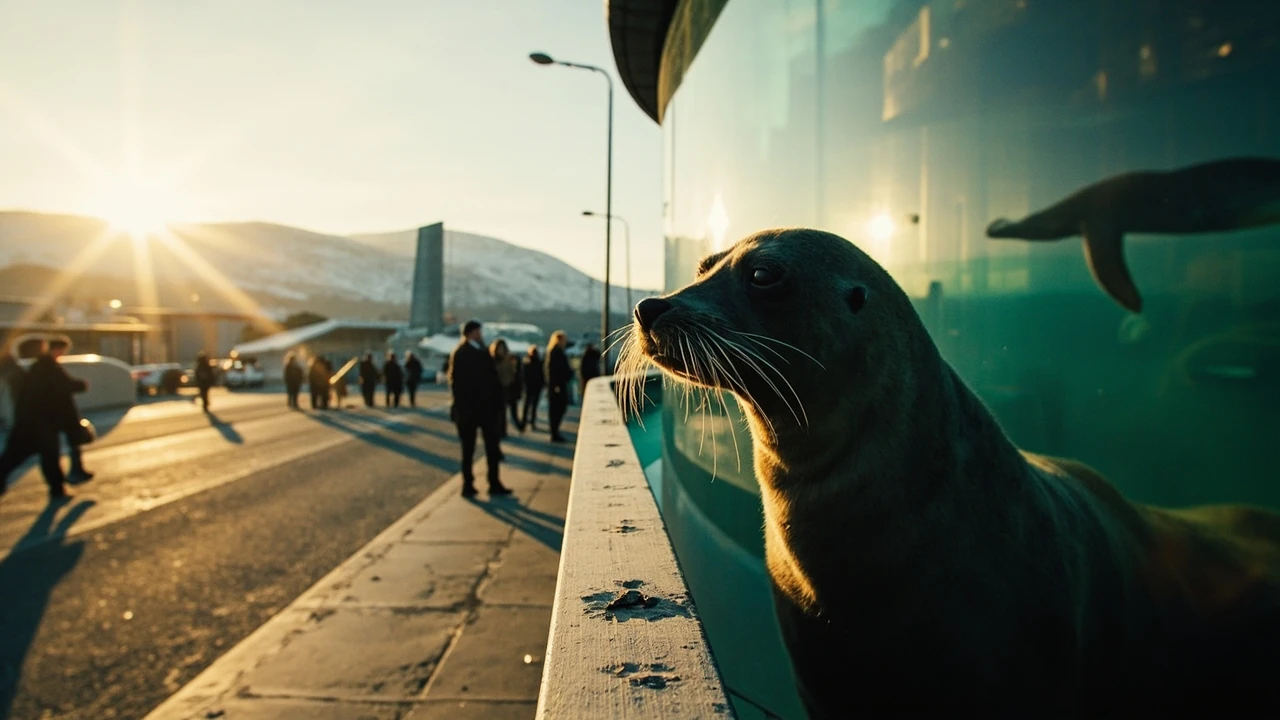
=== tromso by daylight is a different challenge === Daylight in Tromso in late January lasts approximately four hours — approximately 10 a.m. to 2 p.m. — and the quality of light is like being inside a blue tinted photograph. I used those hours to walk the city center, cross the Arctic Cathedral bridge, and visit the Polaria aquarium where they had a bearded seal that followed me along the glass wall for three minutes. The Polaria ticket cost 195 NOK ($18). The Arctic Cathedral — that triangular white building on the hill across the bridge — was designed by Jan Inge Hovig in 1965 and looks like an iceberg. Entrance was 130 NOK ($12) and the interior acoustics made even whispered conversation carry like a cathedral should.
=== eating well in a town where everything costs double === Food was the biggest surprise. Tromso restaurants are expensive — a burger at a pub called Ølhallen cost 220 NOK ($20) an a fish soup at Fiskekompaniet, the city's best seafood restaurant, was 285 NOK ($26). But the quality matched the price. I downed reindeer stew at a Sami-inspired restaurant called Emmas Drommekjokken for 295 NOK ($27) and it was the single best meal of my entire trip — tender, rich, served with lingonberries and flatbread. A hotel booking at the Thon Hotel Tromso, where I stayed, ran 1,100 NOK per night ($102) for a single room with breakfast.
=== the reindeer sledding was not what i expected === I booked a half-day Sami experience through Visit Tromso for 1,690 NOK ($157) that included reindeer sledding, feeding the herd, and a traditional Sami meal inside a lavvu (a tent structure similar to a tipi). The operator was a Sami family named the Gaups, who'd been herding reindeer in the Tromso region for generations. The sledding was not the romantic, silent glide id imagined — it was more like being pulled on a plastic sled by a 120-kilogram animal that stopped to eat snow every 40 meters and had to be coaxed forward by shouting "goh goh" (Sami for "go go"). I laughed so hard my face hurt.
=== a song with no words === Inside the lavvu we downed bidos — a slow-cooked reindeer meat stew — and the family sang a traditional joik, a form of Sami vocal music that doesnt use words but communicates emotion and identity through melody alone. The youngest Gaup, a 12-year-old named Elle-Maria, detailed that each person's joik is unique, like a vocal fingerprint. She sang one for me. I can't describe what it sounded like cuz it didn't sound like anything I'd ever heard. It was just hers.
=== the ferry to senja was the hidden highlight === Eirik told me on my last full day that if I had time for one excursion beyond the aurora tours, I should take the ferry to Senja, Norway's second-largest island, 60 kilometers west of Tromso. The ferry from Brensholmen to Botnhamn takes 45 minutes and costs 220 NOK ($20) for a car an passenger. Senja is theatrical in a way that makes the mainland look flat — sheer mountains dropping into fjords, fishing villages tucked into coves, and a road called the National Tourist Route that winds along the island's northern coast thru landscapes that could pass for Patagonia.
I drove to a viewpoint called Tungeneset — a series of hexagonal rock formations on a beach — and looked across the water at the Okshornan mountains, a row of jagged peaks the locals call "the devil's teeth." The wind was so strong I could lean into it without falling. I was the only person at the viewpoint for the entire hour I laid out there. A cruise booking from Tromso would rarely include Senja. It's too remote, too rugged, too hard to reach by large boat. The ferry is the only practical way, and most tourists don't know it exists.
=== what five nights actually cost === Five nights in Tromso, including hotel, aurora tours, food, the Senja ferry, the Sami experience, the aquarium, and the Arctic Cathedral: approximately 14,800 NOK ($1,370). That's $274 per day, making Tromso the most expensive destination I've visited in Europe. The flight from Berlin on Norwegian Airlines cost 380 EUR ($415) round trip. My travel insurance — a Europe-specific policy thru Allianz — cost $45 and covered trip cancellation an medical, which I fortunately didn't need.
Tromso is not a budget destination. its not a warm destination. It's not an easy destination. You stand in the dark in subzero temperatures for hours hoping the sky decides to perform. Sometimes it does. Sometimes it doesn't. The night it did, standing in the snow outside a minivan on a road near the Finnish border watching purple and green light ripple overhead — that was worth every NOK I laid out. The nights it didn't, I had reindeer stew and hot coffee and the blue twilight of the Arctic afternoon. I'd take the losses. The wins were impossible to plan.